
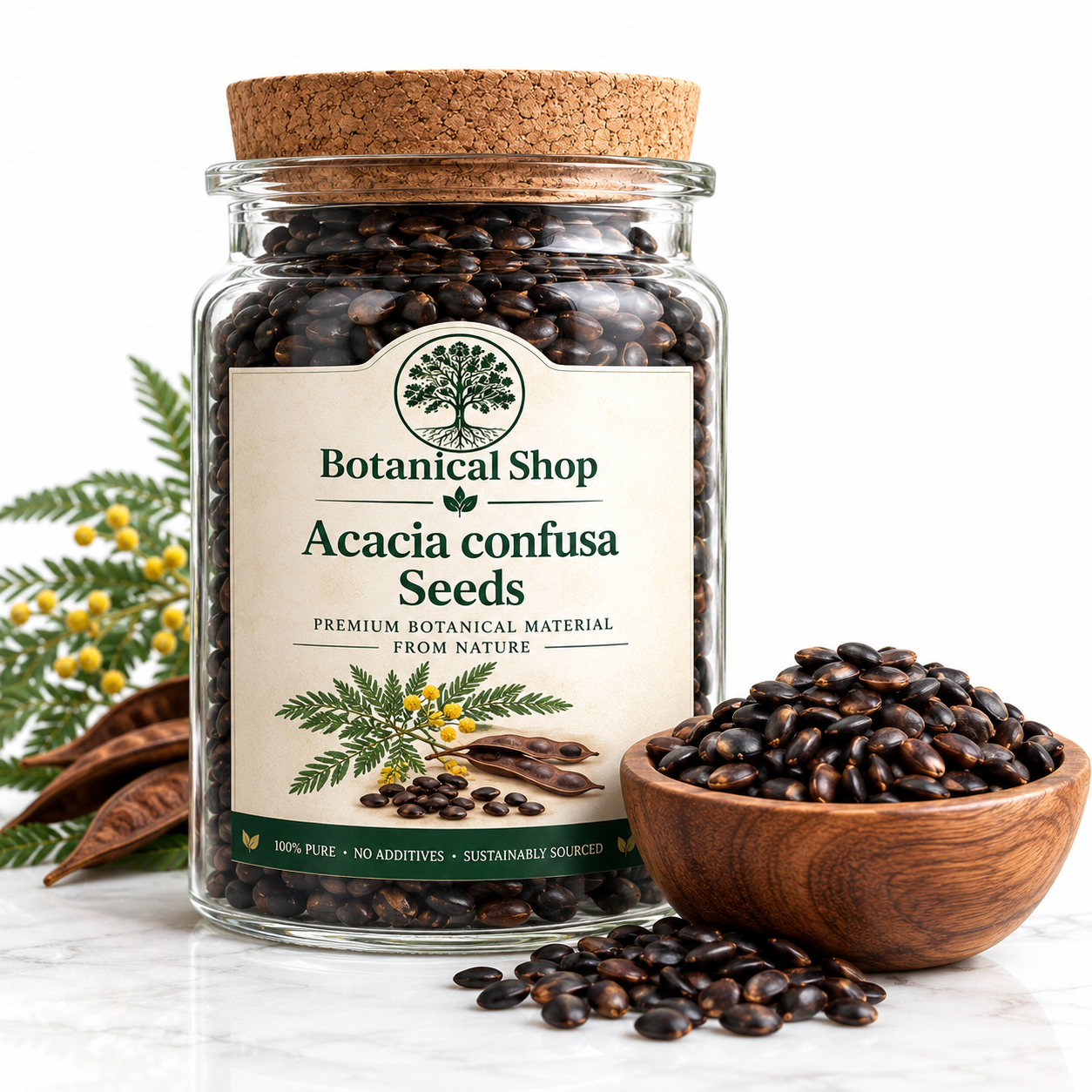
Description
Acacia Confusa Seeds (Formosan Koa) — Premium Botanical Seeds for Research, Cultivation & Collection
If you are searching for authentic for botanical propagation, ethnobotanical research, or educational study, you have found the right source. Our premium seeds come directly from cultivated Acacia confusa trees grown in the tropical regions of Taiwan and Southeast Asia — the native home of this remarkable plant species. We carefully collect and dry each batch to preserve its natural viability, appearance, and structural integrity without any additives, chemicals, or artificial processing.
This is Acacia confusa seed in its most authentic, untreated form — no additives, no chemicals, no artificial processing, and no chemical treatment. It is perfect for botanical propagation, ethnobotanical research, botanical collections, and educational projects. Additionally, we individually label every batch with origin and lot number for full traceability.
What Is Acacia Confusa?
Acacia confusa — commonly known as Formosan Koa or Taiwan Acacia — is a tropical evergreen tree species native to Taiwan and the Philippines. It belongs to the Fabaceae (Leguminosae) family and is recognized for its distinctive sickle-shaped phyllodes, small round clusters of fragrant yellow flowers, and flattened, twisted seed pods typical of the wider Acacia group.
This species grows naturally in warm climates and has become one of the most widely planted reforestation trees on Taiwan’s degraded hillsides, prized for its willingness to grow in poor, rocky, sun-baked soil where little else takes hold. Furthermore, it forms a medium-sized evergreen tree that adapts well to different environmental conditions.
Acacia confusa has gained interest among botanists and plant enthusiasts because of its resilience, fast growth characteristics, and ability to adapt to different environmental conditions. Additionally, it has been extensively studied in forestry science for its nitrogen-fixing ability and unusual tolerance of degraded, compacted, or fire-affected soils, making it a benchmark species in Taiwanese land-rehabilitation research.
Key botanical facts:
-
Scientific name: Acacia confusa
-
Common names: Formosan Koa, Taiwan Acacia
-
Family: Fabaceae (Leguminosae)
-
Native range: Taiwan, Philippines
-
Growth habit: Medium-sized evergreen tree
-
Leaves: Sickle-shaped phyllodes
-
Flowers: Small round clusters of fragrant yellow flowers
-
Seeds: Flattened, twisted seed pods
What Are Acacia Confusa Seeds?
We produce Acacia confusa seeds by carefully collecting and drying the seeds of mature Acacia confusa trees grown in Taiwan and Southeast Asia. This process preserves the natural viability, appearance, and structural integrity of the seeds while creating a uniform material that is easy to store and document in reference collections.
Our Acacia confusa seeds go through the following process:
-
We select mature Acacia confusa trees from cultivated sources in Taiwan and Southeast Asia
-
We carefully hand-collect the seeds at full botanical maturity
-
We clean the seeds to remove surface debris and foreign material
-
We slowly dry the material under natural conditions — no industrial ovens, no forced heat drying
-
We inspect the dried material for color consistency, texture integrity, and absence of contamination
-
We hermetically seal every batch in moisture-resistant packaging and clearly label it with lot number, species name, origin, and form
As a result, the result is a premium seed batch that retains the plant’s characteristic natural appearance, viability, and structural integrity — exactly as serious botanical collectors and ethnobotanical researchers expect.
Why Choose Acacia Confusa Seeds?
Both seeds and root bark forms are available for buyers who want to add Acacia confusa to their botanical collection or propagation project. The right format depends on your specific purpose.
Select seeds if you:
-
Want to propagate your own Acacia confusa trees from scratch
-
Are building a botanical collection that includes multiple plant life stages
-
Are working on propagation studies or educational projects
-
Want to observe the full growth cycle of this remarkable species
-
Are sourcing for a herbarium or institutional specimen archive
Opt for whole root bark if you:
-
Want to preserve the original morphology of the root bark for visual and structural examination
-
Are building an ethnobotanical or botanical reference collection that values specimen authenticity
-
Prefer to process the material yourself to your required particle size
-
Want maximum shelf life from your botanical material
Pick shredded or powdered material if you:
-
Want a ready-to-use material with no additional processing required
-
Are working on formulations or projects requiring fine, consistent particle size
-
Need the smallest possible storage footprint per gram
-
Are preparing reference samples for documentation where uniform texture is important
Both formats come from the same cultivated Acacia confusa source material. Therefore, your intended application entirely determines the choice.
Acacia Confusa Seed Quality and Selection
Quality seeds are the foundation of successful cultivation. Our Acacia confusa seeds are selected based on appearance, condition, and proper storage practices. We focus on providing seeds that maintain their natural characteristics while reducing unnecessary handling that could affect their condition. Proper packaging helps protect the seeds during delivery and storage.
Before planting, growers should follow recommended germination practices suitable for Acacia species. Different environmental conditions, soil types, temperature ranges, and planting methods can influence germination results.
Growing Acacia Confusa From Seeds
Growing Acacia confusa from seeds can be an enjoyable experience for beginners and experienced growers. The process allows you to observe how a small seed develops into a strong tropical tree.
Suitable Growing Conditions
Acacia confusa grows naturally in warm climates and performs best in environments that provide sufficient sunlight and suitable soil conditions. Like many tropical plants, it benefits from good drainage and appropriate moisture management.
Soil Preparation
A well-draining growing medium helps create favorable conditions for seed development. Excessive water retention can negatively affect many plant species, so maintaining balanced moisture is important.
Plant Care
Young plants require proper attention during early development. Providing adequate light, monitoring watering, and protecting seedlings from extreme conditions can support healthy growth.
Seed Preparation
A hot-water soak left to cool overnight mirrors what this seed naturally experiences passing through a hot, dry season before germinating with the first rains. This preparation is worth doing thoroughly since this species tolerates poor, rocky, sun-baked ground so well once established. Bright light and a warm, well-ventilated spot suit the young seedlings, and growth is typically fast and vigorous from the first true phyllodes onward.
Every growing environment is different, and results may vary depending on climate, location, and cultivation techniques.
Quality Characteristics of Our Acacia Confusa Seeds
However, not all Acacia confusa seeds are produced to the same standard. Here is what sets our material apart and what you should look for when evaluating any seed specimen.
Color:
-
Natural dark brown to black tones — the natural color of the seeds
-
Uniform color throughout each batch — no bleaching or discoloration
-
Slight natural variation between batches is normal and expected in genuine botanical material
Texture:
-
Hard, smooth outer coat — each seed holds its structure without crumbling
-
Natural variation in size and shape is normal
-
No signs of moisture damage or mold
Aroma:
-
Clean, mild, earthy botanical scent characteristic of dried seeds
-
No musty, sour, chemical, or fermented odor
-
The natural aroma fades slightly over time but remains detectable in properly stored material
Purity:
-
Zero additives, fillers, or artificial processing of any kind
-
No chemical treatment or enhancement applied
-
No signs of mold, foreign material, or pesticide use
Batch labeling:
Every batch includes: Acacia confusa · Formosan Koa · Lot number · Origin · Form (seeds) · Packaging date
Acacia Confusa Seeds vs Root Bark
Acacia Confusa Seeds: ideal for propagation, cultivation, and observing the full growth cycle from germination to mature tree.
Acacia Confusa Root Bark: ideal for ethnobotanical research, botanical collections, and natural dye projects.
Both formats come from the same cultivated Acacia confusa source material. Therefore, your intended application entirely determines the choice.
Common Applications for Acacia Confusa Seeds
Buyers source Acacia confusa seeds for a wide range of legitimate botanical, educational, and creative purposes. The most common applications include:
Botanical propagation and cultivation: Growers and horticulturists use Acacia confusa seeds to propagate new trees, observing the full growth cycle from germination to maturity.
Ethnobotanical research and collections: Researchers and institutions building reference collections of significant tropical plant species regularly include Acacia confusa seeds as a key specimen. The seed format allows for genetic and morphological examination.
Botanical identification and taxonomy study: The visible size, color, and structure of Acacia confusa seeds make them a useful physical reference for plant identification projects and botanical taxonomy coursework.
Educational projects: Educators use Acacia confusa seeds to teach students about plant propagation, germination, and the life cycle of leguminous trees.
Archival and documentation projects: Educators, historians, and archivists working with materials related to traditional Taiwanese and Southeast Asian plant use maintain Acacia confusa seeds as physical reference documents alongside written and photographic records.
Academic herbarium collections: University and institutional plant collections include Acacia confusa seeds for teaching purposes and long-term preservation of significant botanical species.
Storage Instructions
Proper storage is essential to maintain the viability, appearance, and structural integrity of your Acacia confusa seeds over time.
-
Store in a sealed, airtight container — a glass jar with a tight lid or a vacuum-sealed bag is ideal
-
Keep in a cool, dark location away from direct sunlight and heat sources
-
Avoid humid environments — place a food-grade silica gel desiccant packet inside your storage container
-
Do not store near strongly scented materials, essential oils, or aromatic herbs — the seeds can absorb surrounding odors
-
Label your container clearly: Acacia confusa · Formosan Koa · Seeds · Lot number · Date received
-
Ideal storage temperature: below 20°C (68°F)
-
Estimated shelf life: 24 to 36 months under optimal conditions
Under these conditions, your Acacia confusa seeds will retain their natural viability, appearance, and structural integrity for well over two years.
Our Sourcing and Quality Commitment
At Botanical Shop, we source Acacia confusa seeds directly from cultivated specimens grown by local communities in Taiwan and Southeast Asia. We do not source wild-harvested material.
Every batch we receive goes through the following verification steps before we list it for sale:
-
Origin confirmation: cultivated Acacia confusa, not wild-harvested
-
Physical inspection: color, texture, aroma, and structural integrity checked against quality benchmarks
-
Moisture check: material must be fully and evenly dried before acceptance
-
Contamination check: no mold, foreign material, or signs of pesticide use
-
Batch labeling: every unit receives a unique lot number for full traceability
-
Packaging: hermetically sealed in moisture-resistant packaging immediately after inspection
Consequently, we work with communities that practice responsible, sustainable harvesting — respecting the natural growth cycles of mature Acacia confusa trees and ensuring that cultivation, not extraction from wild populations, is the basis of all our supply.
Compliance and Intended Use
Acacia Confusa Seeds — (Acacia confusa / Formosan Koa) — is sold strictly as a botanical specimen for educational, propagation, archival, collection, and reference purposes only.
This product is not intended for human consumption. The seller makes no claims regarding therapeutic, medicinal, psychoactive, or any other physiological properties of this material.
It is the sole and complete responsibility of the buyer to verify all applicable local, state, and federal laws regarding the purchase, possession, and use of this material before placing an order.
-
Botanical name: Acacia confusa
-
Common name: Formosan Koa, Taiwan Acacia
-
Form: Whole natural seeds
-
Origin: Taiwan / Southeast Asia (cultivated)
-
Processing: Hand-collected, sun-dried, no additives
-
Additives: None
Related Products
Acacia acuminata Root Bark (Whole)
$120.99 – $460.99
👉 View Product
Brazilian Mimosa Hostilis Inner Root Bark Powder (MHRB)
$129.99 – $559.99
👉 View Product
Brazilian Mimosa Hostilis Inner Root Bark (Shredded)
$129.99 – $559.99
👉 View Product
Mexican Mimosa Hostilis Inner Root Bark (Shredded)
$129.99 – $500.00
👉 View Product
Mimosa Hostilis Seeds (Mimosa tenuiflora)
$89.99 – $799.99
👉 View Product
Reviews
There are no reviews yet.